 Home
Home Games
Games Articles


When the bullet called “Big Bang” shot through the smoky air of the Jazz Club, I, as the watch merchant Knox, did not try to stop it. On the contrary, I reached out and grasped the trajectory of its flight — time was stretched, folded and reversed like a film between my fingers. On the path of the bullet, the nebula began to conceive, the stars were born, and they collapsed into a black hole at the next moment. _Genesis Noir_ told me that in this triangular murder case involving God, man and a jazz singer named Miss Mass, the only way to find the real culprit is not to investigate, but to interpret every breath of the universe from birth to silence.
The aesthetics of the game is a black and white jazz visual poem. All existences float on the deep space-like background in the form of silhouettes, ink fading or geometric light spots. My interaction is not clicking, but “flirting”. If you stroke the spiral arm of the Milky Way with your finger, the stars will flow like notes; if you hold down an expanding nebula, it can be pinched into a new constellation shape by me. The detective process has become an improvisation on a time and space scale. In order to find clues, I may need to let a dying sun explode a supernova in advance and illuminate a forgotten time fold with its light; or, I have to reverse the expansion process of the whole universe, let the discrete galaxies gather again, and piece together the original picture before the event.
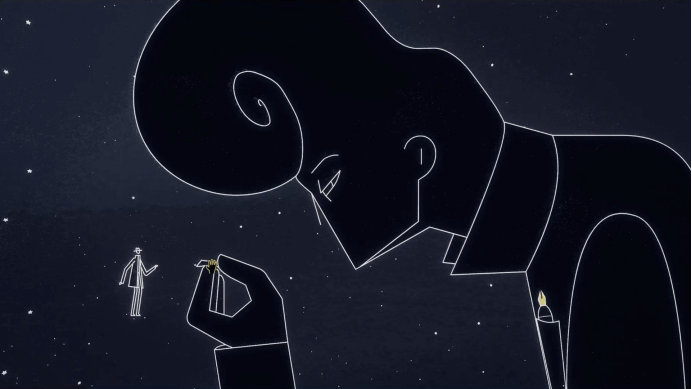
The most fascinating paradox is that every cosmic manipulation carried out to “solver the case” is changing the scene of the crime. In order to listen to the song of Miss Mass at the moment of explosion, I had to let time loop infinitely on a certain note, but thus gave birth to a parasitized deformed civilization on the melody. In order to check the material of the bullet, I repeatedly let it fission and fuse on a microscale, but inadvertently created countless fleeting mini-universes. I, a detective, have become the most erratic and creative variable in the history of the universe. The face of the true evil is getting more and more blurred, while the fingerprints left by myself on the space-time structure are getting deeper and deeper.
As I explored, I gradually realized that the essence of this “murder case” was not a crime, but an inevitable heartbeat of the universe — a destruction that must be accompanied by creation. God, man and singer may be just different faces of the same primitive power. In the second half of the game, I no longer look for the murderer, but try to find a “perfect chord” that can make all possibilities coexist and let love survive in destruction. I arranged the elementary particles in the chaotic quantum field, looking for the vibration frequency that stabilizes the existence of matter like a tuning instrument; I salvaged the swallowed pieces of information at the edge of the event horizon of the black hole, trying to spell back an unburned love poem.
In the end, I didn’t get the truth and didn’t stop the explosion. The game gave me a choice: let the cycle of time continue and repeat this magnificent and painful moment endlessly; or accept the explosion as the inevitable price of creation and guard the smallest seed called “possibility” in the embers. The screen fell into pure darkness, and then a little familiar starlight lit up again in silence.
What _Genesis Noir_ leaves me is not the satisfaction of solving the case, but a kind of awe and relief of cause and effect. It allows me to experience the ultimate boundary that detectives can reach: when the object of investigation is the universe itself, every question is changing the answer, and every touch is creating new puzzles. Perhaps the biggest discovery is that in this endless cosmic jazz, all of us — detectives, victims, murderers, lovers — are just a few improvised notes, briefly intertwined in the afterglow of the explosion, and then echoed forever.