 Home
Home Games
Games Articles


I double-clicked the film icon called _Ambrosio_, the screen fell into darkness, and then a rough particle lit up. A woman — Marissa Marcel, the girl who should have become a superstar — is wearing lipstick in front of the mirror. The camera is a close-up, and her eyelashes are trembling. The director shouted to stop, and she relaxed in an instant and smiled tiredly in a certain direction outside the camera. The next second, my cursor slid over the lipstick tube in her hand, and the picture flashed. I was thrown into 20 years later: in a cheap horror movie in the 1970s, another woman was writing a distress signal on the mirror with the same lipstick. Time is not a line, but a dark maze made up of random objects. My exploration began with an unconscious gaze.
The game is handed over to me with three full-length films, countless clips and audition videos, which together constitute Marissa Marcel’s short and strange career. My tools are cruelly simple: a film player can move forward and backward frame by frame; a free idea allows me to find “matching” between any two frames. Matching a look, I jumped from a romantic comedy in 1968 to a political thriller in 1970; matching the opening and closing of a door, I jumped from the shooting site to a late-night private quarrel. I have become a scavenger of time, digging under the appearance of the movie, and every time I dig, I change my definition of this woman. At first, she was a genius; then, she was a victim; later, she may be a manipulator. The truth continues to multiply in the fragments and never solidifies.
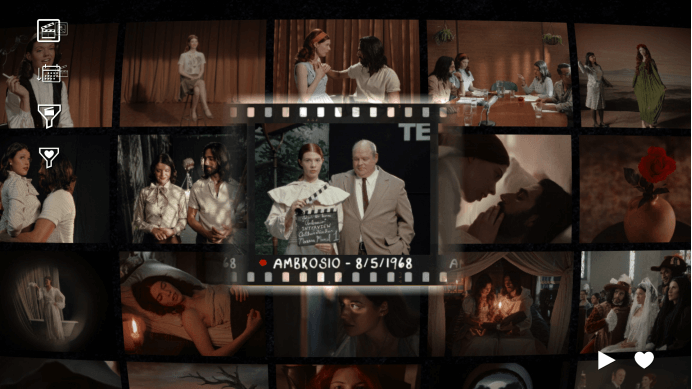
This kind of “watching” gradually becomes aggressive. In order to find a match, I repeatedly replayed some clips to see how she fell, cried, kissed and died again and again. The director’s instructions, the whispers of the actors, and her own momentary expression were all magnified, examined and extracted from the original context by me. I realized that I was repeating everything the film industry had done to her: cutting her into usable expressions and gestures, consuming her pain and charm, and calling her “seeking the truth”. When I paused the picture and enlarged the outline of the camera reflected in her pupils, I suddenly leaned back, as if I was burned by my own gaze. I am both a detective and the last accomplice in this decades of voyeurism.
The most trembling design of the game is that it reveals how “performance” swallows up reality. In a test section, Marissa performed fear as required. For the first time, she acted pompously, and the director shouted to stop. The second time, she was silent for a long time, and then raised her eyes — at that moment, I felt a chill outside the screen. That’s not a performance, but a leak of some kind of real fear. However, this “real” was immediately included in the film, becoming the proof of her “superb acting skills”, waiting to be consumed by latecomers like me. The boundaries between reality and fiction, private emotions and professional performance are completely dissolved in these films. Her life became a never-ending and watched performance.
When I finally triggered the most hidden supernatural clips that were beyond the reality of the movie, the shock did not come from the strange power. Instead, I found that even in these obviously “unreal” images, Marissa’s eyes still pointed at the camera — pointing at me. She seemed to be questioning and inviting. At that moment, all the film theories and detective logic collapsed. This is not a mystery waiting to be solved, but an eternal reincarnation about staring. I tried my best to see her clearly, but in the end, I only saw my greedy eyes that tried to take other people’s lives as a “story”.
After clearing the customs, I didn’t get any clear answer about Marissa’s whereabouts. The screen turned black, leaving only my desktop wallpaper, an ordinary landscape photo. But I can no longer “simply” watch any video. Immortality did not give me a biography of a star. It gave me a cold scalpel and let me cut open the act of “watching” itself with my own hands: its desire, its violence, and its inevitable distortion and plunder of reality while building a narrative.
Nowadays, when I occasionally see the fleeting complicated eyes of an actress in an old movie, I think of Marissa Marcel. The woman who only existed in the broken film became a permanent scratch on my visual conscience. She reminded me that every recorded picture may be a soul between shouting and silence, the moment that is frozen and no one can really interpret. And we, the audience, may have become the deepest wound in the story before the beginning of the story when enjoying the pleasure of spying and solving puzzles.