 Home
Home Games
Games Articles


The moment I pressed the “Start” button and the screen lit up, I thought the museum’s collection exploded.
Jesus’ head was roughly grafted on the armor of a knight. The background was the wedding scene of a farmer in Bruegel, while the mouth of the speech came from Venus of Botticelli. This is not a game. This is a drunken fight against the history of art. And I, a “nobleman who is determined to take revenge”, wearing a dress made of five or six different portraits, stood in this world of sacred and secular fragments, and had a funny doubt about my existence for the first time.
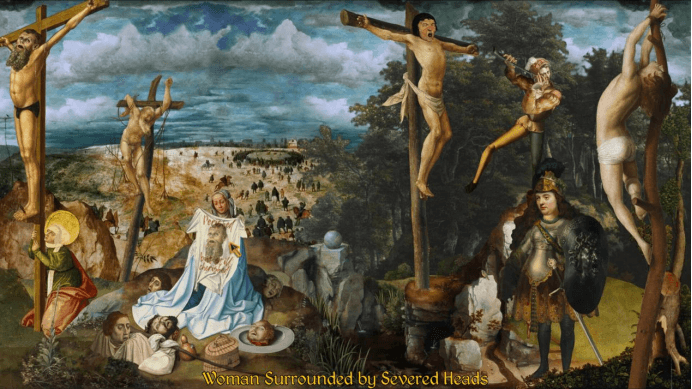
The logic here comes from sneezing. I need a key, but the keyhole is in the eyes of a dead fish in a still life painting. The guard blocked the way. I tried to “persuade him”. The dialogue option was to recite an unrelated sonnet, but he was so moved that he covered his face and took the initiative to give way. I want to flip through a book to get clues, but the pages are full of cut landscape fragments. I have to align the end of a forest with the spire of a church like a puzzle, and then the book will reluctantly spit out a few meaningless Latin words. Every “success” in solving a mystery is accompanied by a gentle slap in the face of rational cognition. I quickly gave up understanding and turned to embrace the nonsense intuition.
The most disturbing thing is not the absurdity itself, but that all the characters are completely unaware of it. They used the most solemn portrait expressions of the Renaissance, spouting the most nonsensical lines., and had the most off-topic debate. A noblewoman made of fragments of the statue of Our Lady of Raphael will seriously discuss with you the “stones that will ruminates” in her garden. This extreme context misalignment creates a strange sense of alienation. You can’t immerse yourself, because you are always reminded that everything you see is a “counterfeit” that is violently cut and pasted at will. Even the “revenge” motivation you play seems to be like a clumsy prop borrowed from other tragedies in this world.
The game process turned into a continuous deconstruction carnival. When you “bribe” a tax officer composed of angel wings and soldiers’ legs with grapes drawn from the altar of the wine god, you deconstruct not only the goal of the game, but also the meaning of the act of “bribe” itself. When you change the mood of an NPC by adjusting the order of several hanging paintings (making the scene of mourning Christ close to the pastoral song), you deconstruct the fragile causal relationship between “narrative” and “emotion”. The solemnity, compassion and sacredness carried by elegant art are all dissipated in this stitched furnace, leaving only the most primitive and absurd collision between colors, lines and shapes.
And in this ruin composed of the remains of meaning, a brand-new freedom that makes people’s stomachs and spines chills was born. Since all the rules are fake and all the narratives are collage, every choice I make, no matter how deviant, has gained legitimacy. I can use a stolen rib belonging to a saint as a crowbar, or I can use a randomly combined hymn as a weapon. The “progress” of the game is no longer that I approached the “truth” or completed the “revenge”, but how strange and self-consistent dance I danced in this grand and meaningless masquerade ball.
In the end, my revenge was “completed” in a way that could not be summarized. There is no epic duel, no truth, only a more chaotic and brilliant collage scene, and then the screen slowly darkens. I collapsed on the chair, not tired, but hit by a huge and absurd sobriety.
_The Procession to Calvary_ does not tell a story about faith or morality. It is a joyful murder attempt against the “meaning” itself. It proves in the most disrespectful way that our undoubted sense of narrative, logic and artistic nobility may be just an elaborate and habitual collage. And when we dare to pick up the scissors, cut these inherent pictures, and re-bond them like a drunkard, what we get is not nothingness, but a dizzying and liberating smile. The laughter echoed in the empty room, making you couldn’t help looking at the wall — every neat painting hanging there seemed to be trembling slightly, for fear that the next one would be dragged into this endless and lively deconstruction carnival.